Mavi Boncuk |
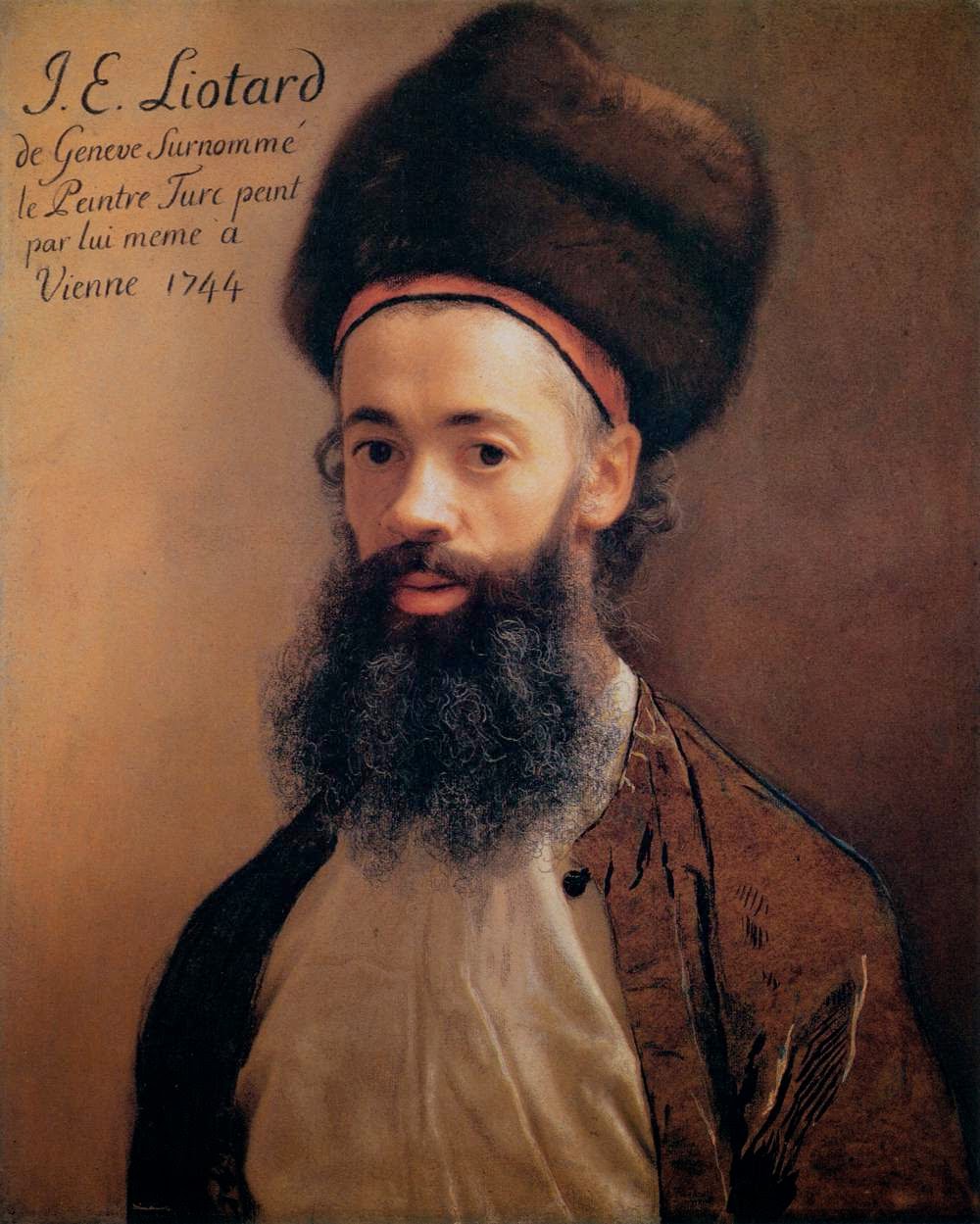
German traveller, Karl Gottlob Küttner, when passing the artist in a public procession in Geneva one day the wrote in his journal: “Amidst the crowd of people I noticed a grotesque personage attired in a sort of bathrobe and night cap which, as I learned later on, was a turban and who carried a great Turkish sword. It was none other than the old painter Liotard”.[1]
This transformation followed his five-year stay in the Ottoman Empire, at which time Liotard adopted a Turkish costume and grew a full-length beard[2] that eventually reached his waist. This may have facilitated his contact with the Turkish and Moldavian nobility there... Liotard appears as a self-styled “peintre turc”; a title he includes in the signature. The signature also states that the artist was a citizen of the republic of Geneva, perhaps to inform those spectators taken in by Liotard’s disguise. While it is true that Liotard did not want to be mistaken for a “real Turk,” his wish to specify his origins probably also had to do with his sense of pride in his political status. Being a citoyen of Geneva signified one’s affiliation with the Republic’s ruling social and political elite, something of which Liotard would have been immensely proud.
This would have been of particular significance given his father’s relatively-recent access to the bourgeoisie in 1701. Also, in the larger European context, Liotard’s public assertion of his political identity would have made him an even greater rarity and thus would have contributed to raising the interest in his work among potential clients. Liotard continued to dress in Turkish clothing[3] throughout the rest of his career, creating a sensation that helped him develop a huge and devoted clientele some of whom commissioned Liotard to make their portraits in Turkish dress.
Source: The Spectacular Self: Jean-Etienne Liotard’s Self-Portrait Laughing by Julianna M. Bark
[1] 2 “Parmi ces gens, je remarquai un personnage grotesque dans une espèce de robe de chambre, avec un bonnet de nuit qui, à ce que j’appris ensuite, représentait un turban, et un grand sabre turc. C’était le vieux Liotard.” As quoted in Voyageurs européens à la découverte de Genève: 1685-1792, J.-D. Candaux (ed.), Geneva 1966, 119. For full text, see Briefe eines Sachsen aus der Schweiza an seinen Freund in Leipzig, Leipzig 1785-1786.
[2] This was the case of the Irish archaeologist and theologian Richard Pococke (ca. 1738-42, Geneva, Musée d’art et d’histoire) who, like Liotard, is attired in a Turkish costume and wearing a beard. Beards, incidentally, were subject to a heated debate in the eighteenth century. For the famous naturalist Carolus Linnaeus the beard was associated with masculinity, virility and strength. He believed that facial hair grew as a result of “excess bodily fluids” and reflected “resorbed semen”. It is perhaps on account of this association that eighteenth century European men did not, in general, grow beards. On the contrary, shaving became a sign of Western civilization at that time.9 Given this interpretation of facial hair, it is understandable how Liotard’s beard often caused a stir and sometimes drew the artist negative publicity during his career.
[3] Posing for a portrait in Turkish fancy dress became a highly fashionable mode of high society portraiture in the eighteenth century. For more information on this, see A. Ribeiro, “The dress worn at masquerades in England, 1730-1790, and its relation to fancy dress in portraiture”, Ph.D. dissertation, Courtauld Institute, London University 1984 and P. Stein, “Exoticism as metaphor: Turquerie in eighteenth-century French art”, Ph.D. dissertation, New York University 1997.